
Sunday, March 31, 2013


Saturday, March 30, 2013
FOTO FICTION OF THE DAY
 A Gift from God
Down in the bottom of the cupboard
beneath the sink, way in back, a bottle of rat poison. A black and white label,
faded and worn, and printed on the label: Rat Poison. Skull and crossbones. A
cautionary message at the bottom in a rectangular box. Small print. Who put it
there, how long ago: a mystery. The seal: unbroken. Never used.
In Milan, onlookers gawk. Camera-toting
tourists the crew shoos away. Yet they linger. Others arrive. The breeze blows
lightly. When it doesn’t a fan is positioned, plugged in, strategically aimed.
Hours plod. One’s brain coagulates like a pudding in the sun. The next day:
Madrid. The day after: Rome. Evenings with strangers pretending to be friends,
drinking, laughing, posing. One’s feet ache and one longs for real friends,
real love, a real life.
Amadeo will say anything to get what he
wants. You are beautiful. A vision. An angel. Bellissima! He will make your heart melt into a puddle of fatuous
egotism. But you know it. You move arms here, legs there, eyebrow up, chin
atilt, lips pursed, eyes up, down, sideways, any way he wants. Amadeo gets what
he wants. The hotel a blissful refuge after fourteen hours of artifice. A place
to be alone. A different kind of alone. In the day: seen but unknown; in the
night: unseen and unknown, lonesome.
In the front of the cupboard: dish
detergent, scouring pads, a small red fire extinguisher (do they come in any
other color? yellow perhaps?). A sheet of linoleum lines the cupboard floor, a
geometrical pattern of different sized rectangles, large ones, medium ones, and
small like the warning box on the bottle in the back. Lurking back there like a
very rat itself, tiny sharp teeth bared. The rest of the small flat: quiet. The
telly shut off for the night. Armchairs in the sitting room: empty. Framed
photos on the wall: a child: different photos at different ages: a very pretty
child at every age. The fridge humming almost imperceptibly in the kitchen. The
sound of a person breathing: imperceptible: as good as nonexistent. The
cupboard down below. The bottle way in back. The chairs, the photos, the
fridge, the breathing.
First stop: LaGuardia. A week in
Manhattan. Beneath the Queensborough Bridge. On the deck of the Staten Island
Ferry. Lincoln Center. Central Park. It’s cold, very windy, crowded, loud. Next
stop: LAX. A week in Los Angeles: Hollywood Boulevard. Beverly Hills. The pier
at Santa Monica. Hotel rooms. Smiling, laughing, drinking. Sixteen hour days.
Countless shots, pretty in all. But pretty is easy, pretty is everywhere,
especially in California, Amadeo wants more than pretty and he perseveres until
he gets it. Finally: Heathrow. South Tottenham. A two week holiday. The flat at
the end of Hampden Road, just near Ducketts Common: a sight for sore eyes.
Mad not to capitalize on such beauty,
anyone would say: most did. A gift from God. University can wait, boys can
wait, hubby and children and all that lot can absolutely bloody well wait.
Think of the money, the travel, the glamour. Think what the money can do: for
you, for your mum. Just hold still for a photo, nothing easier. Wear this,
stand here, look there, smile, wink: you’re good as gold. Do it for your mum.
Nothing to stop you. Daddy long gone. No other family to speak of. Do it for
your mum. If not for yourself, for your mum.
Now it’s Berlin. Tomorrow Vienna.
Amsterdam the week after. More money than a dream can hold. Travel, glamour,
locals and tourists gawking: royalty come to town. Beauty as they’ve never seen
but only dreamt of, an ethereal being breathing the rarefied air of privilege,
wealth, fame, luxury. They want to stand as close as they can, breathe the same
air, live the same dream. The dream into which one must be born. One cannot
acquire it by work or subterfuge nor fake one’s credentials nor argue on the
basis of virtues not clearly visible. But how wonderful it would be to stand in
the lights, in the camera’s eye, adored, complimented, fawned over, lusted
after. Paid enormous sums merely to stand, clad in the finest apparel, and
smile. See how easily she does it: tilting her lovely head, fixing her eyes
just to the left of the camera in a steely gaze, cheek bones in sharp relief,
earrings dangling, skirt fluttering, shapely calves flexed, and do what must come
so easily: smile. With nothing in her adorable little head but the thought of a
dimly lit kitchen in a small flat in South Tottenham, a cupboard door standing
ajar beneath the sink, a bottle with a black and white label standing on the
kitchen table, the sound of a humming fridge and no other sound at all, neither
the telly nor the sound of a person breathing. A small flat with nobody in it
and no reason ever to return to Hampden Road.
Just stand, tip your head, and smile.
Nothing easier.
D.E. Sievers


Friday, March 29, 2013

Thursday, March 28, 2013
FOTO-FICTION OF THE DAY
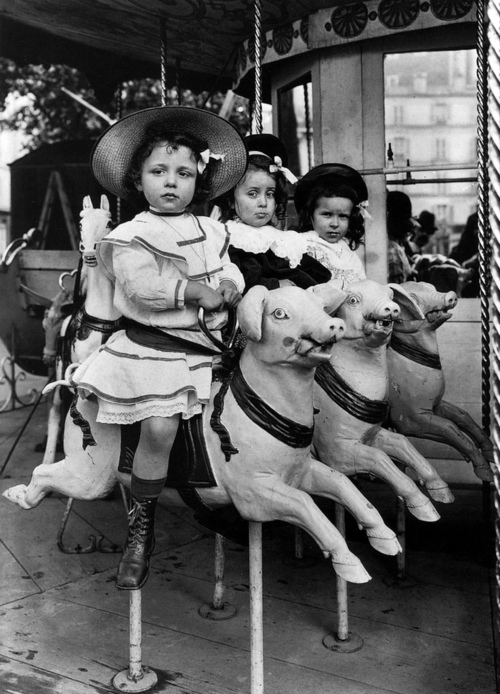 Carousel
There were three sisters in my childhood home. A recipe for jealousy and internecine
rivalries, you say? For countless
instances of quiet or clamorous contempt?
For secrecy and duplicity and festering resentments, for cleverly laid
deceptions, insidious cabals, simmering contentiousness associated with the perpetual
vying for attention, affection and favor from those within the home and
without? Yes, undoubtedly a recipe for
all those things and more. No fictitiously
happy March sisters here, I’m afraid. No
factually blitheful Bronte sisters penning elegant prose and verse in perfect
harmony beneath a common roof. Though I
tend to question that alleged harmony, and the March sisters certainly
weathered days of discord.
The oldest was Magda, who received the lion’s share of
attention, largely due to a personality that would seize it when she wasn’t
getting it. She was outsize even as a
little girl, Magda was. She was loud and
demanding, cantankerous when she didn’t get her way, vain and boastful and
bullying and possessing of all the unpleasant qualities you tend not to wish
for, but rather to despise, in an older sister.
The youngest was Jane who, by virtue of being the baby of
the family, received whatever attention
was left after Magda had taken her share.
Jane’s approach to getting what she wanted, what she needed, consisted
of staging a pity party to which she invited others with her pouting, her
sulks, the crocodile tears issuing from those big sad limpid eyes. Jane tended to lurk in hallways and behind
closet doors in order to obtain intelligence she could later use to
advantage. A clever tactician, was Jane.
The middle child was Yvonne, who functioned as a kind of
buffer between Magda and Jane. As a
witness to sins committed or not committed, as an arbitrator in domestic
disputes, and as a diplomat to forge a ceasefire and precarious peace in times
of war. Yvonne’s was the calm voice of
reason, and as such, tended to go ignored and unheard. Her voice frequently suffered an
unacknowledged death by drowning amid the boisterous boasts of Magda and the
plaintive supplications of Jane. Yvonne was the child unseen, unheard, and
sadly, unknown.
The three sisters at length grew up into women. One became a successful business
professional who ran her own company, amassed great wealth, graced the covers
of success-oriented journals, and died suddenly of a heart attack before the
age of fifty. The second married young,
became a loving but harried mother of four, and lived a dull and thankless life
of meek subservience to her brutish and self-centered husband until he died in
his sixties, leaving her penniless. The
third sister traveled the world, enjoying a succession of passionate love
affairs with men who treated her like a queen; she became a prolific writer and
artist who wrote stories and painted pictures wherever she went, selling or
trading them for enough to meet her needs; she swam in the ocean, climbed
mountains, crossed deserts, and drank deeply from a cup of life that each day,
depending on where she was that day and in whose company, contained a
differently flavored nectar, often sweet, sometimes strong, and rarely bitter.
Can you guess which sister was which?
Looking back at childhood photographs, I can scarcely
believe these three creatures were borne of a common mother, in close
succession. And yet, there is no
refuting the documentary evidence. Three
young girls growing up in the same household, reared by the same parents, exposed
to the same values and standards in the same community and yet so markedly
different in adulthood. Like three
hatchlings from the same clutch of eggs, one growing wings, another developing
gills, and the third sprouting four legs with which to crawl upon the earth.
It made me terribly sad to learn of Magda’s death. She was such a force of nature, so strong and
capable, and while I don’t feel I really knew her very well, I did have the
sense she was never truly happy or at peace.
Her goals and ambitions were larger than life, and her achievement of
them didn’t seem to bring the degree of satisfaction she’d expected. She seemed always to be fighting tooth and
nail for a level of recognition and acknowledgement that never came.
Yvonne has always been the kind of person others refer to as
a saint. Which is to say she possesses
the qualities of a martyr, putting everybody else’s needs above her own. But then, even as a child she was the one who
was always trying to keep everyone else happy, trying to soothe hurt feelings,
quell rising tempers, and resolve misunderstandings. Yvonne has lugged a heavy cross through life,
and does so still, with her four children, even now as adults, adding to its
weight rather than sharing a portion of their poor mother’s burden.
And I am Jane—had you guessed? I still sometimes go all big-eyed and pouty to
inspire sympathy, and still observe the world around me more keenly than my
sisters ever did. I like to think I
don’t lurk in hallways and behind closet doors, but I do pay attention to what
others are doing. Being observant and
curious, and yes, perhaps even nosy, has served me well, helped me get the kind
of life I want for myself. I depend on
nobody and nobody depends on me. I go
where I please and do what I like and have enjoyed a very happy life up to now
(knock wood). I suppose I’ve been pretty
lucky too, as I have always managed to get just what I want. But then, you knew all along, didn’t
you? The baby of the family always gets
her way.
D.E. Sievers
Subscribe to:
Posts (Atom)